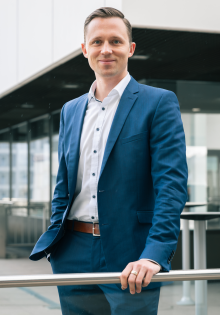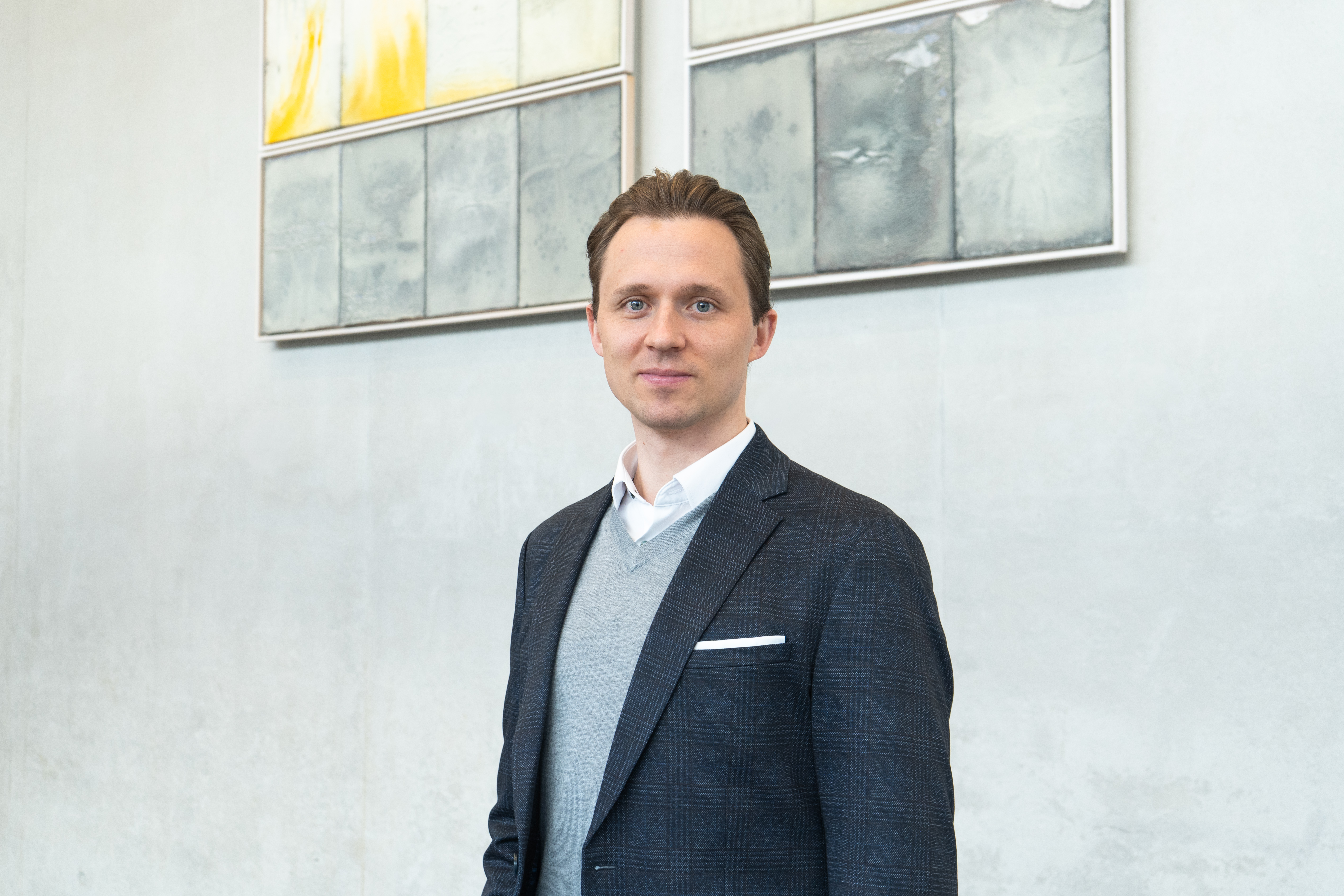
Since the winter semester 2025/2026, Prof Dr Franz Strich has joined the Faculty of Business Administration and Economics as a newly appointed professor. As holder of the Chair of Digital Responsibility in the Department of Information Systems, he is dedicated to a topic that is becoming increasingly important in the face of rapid technological developments: the responsible shaping of digital technologies in business and society. People are always at the centre of his work - as actors, as those affected and as the shaping force of digital transformation.
A career with an international flavour
Franz Strich's academic career has been characterised by various stages and changes of perspective. After completing his studies, the Berlin native moved to Passau for his doctorate and later to Bayreuth, where he worked as a postdoctoral researcher. An important international station followed in 2022 with his move to Australia: he worked at the Deakin Business School in Melbourne for several years in research and teaching. "I had never been to Australia before - suddenly I had to leave everything behind and start again. It was challenging, but incredibly enriching both professionally and personally," recalls Strich.
Despite his positive experiences abroad, he made a conscious decision to return to Germany. With his appointment to Paderborn, he finally found a location where his interests could be institutionally focussed. "Here I can do exactly what has driven me for years - and with a chair that brings all these topics together," says Strich.
From a psychological perspective to business informatics
Franz Strich originally studied psychology. What initially emerged from an orientation phase proved in retrospect to be the central foundation of his academic career: "My studies gave me a deep understanding of human behaviour, decision-making processes and social dynamics - skills that have significantly shaped my research today."
The transition to economics and now to business informatics is not a break, but a logical extension. His interdisciplinary background enables him to combine psychological theories with economic and information technology issues.
Research at the interface of people, organisation and technology
"Technologies not only change processes, but also self-images, roles and identities - often subtly, but with great effect." A particular focus of Strich's research is therefore on the question of how people react to new technologies - whether they accept, reject or actively shape them - and what consequences this has for teams, organisations and society.
He is particularly interested in the transformation of identities and roles in work contexts characterised by technology. New information systems can turn employees into pioneers, but can also push them into conflicts or undesirable roles. Strich analyses how such dynamics arise and how organisations can react to them by designing technology, processes and collaboration. The aim is to create a framework in which technological innovation does not lead to excessive demands or marginalisation, but instead enables sustainable value creation.
He also categorises current developments in artificial intelligence in this context. Hybrid models in which humans and AI work together are particularly effective. However, this requires responsible implementation that takes cultural, social and ethical aspects into account. Otherwise, there is a risk of acceptance problems with serious economic consequences and a high level of psychological stress in everyday working life and beyond.
Strich's understanding of digital responsibility is deliberately comprehensive. In addition to ecological issues, he focuses on social and societal dimensions: fair access to digital technologies, the development of data skills and the design of digital work under conditions that are beneficial to people.
Teaching as a place of dialogue and reflection
In teaching, Prof. Dr. Strich pursues a dialogue-oriented approach. "For me, university is above all a place of dialogue - students should learn to reflect, justify and take a position," he explains. His courses combine ethical principles with concrete application examples from business and society.
Co-operations with companies, case studies and guest lectures are intended to strengthen the practical relevance and prepare students for later decision-making situations. The aim is to sensitise students to use technological possibilities not only efficiently, but also responsibly.
Prospects for research and society
Franz Strich is optimistic about the future. "If we use technology correctly, it can create freedom - for meaningful work, better decisions and more added value for society," he is convinced. However, the prerequisite for this is that technological developments are not passively accepted, but actively shaped.
At Paderborn University, Strich wants to continue to drive forward this creative approach - in research, teaching and interdisciplinary dialogue. His aim is to enable students and stakeholders from business and society to help shape digital transformation in a reflected, competent and responsible manner. He is convinced that the digital future will not be determined by technologies alone, but by the people who develop and use them.