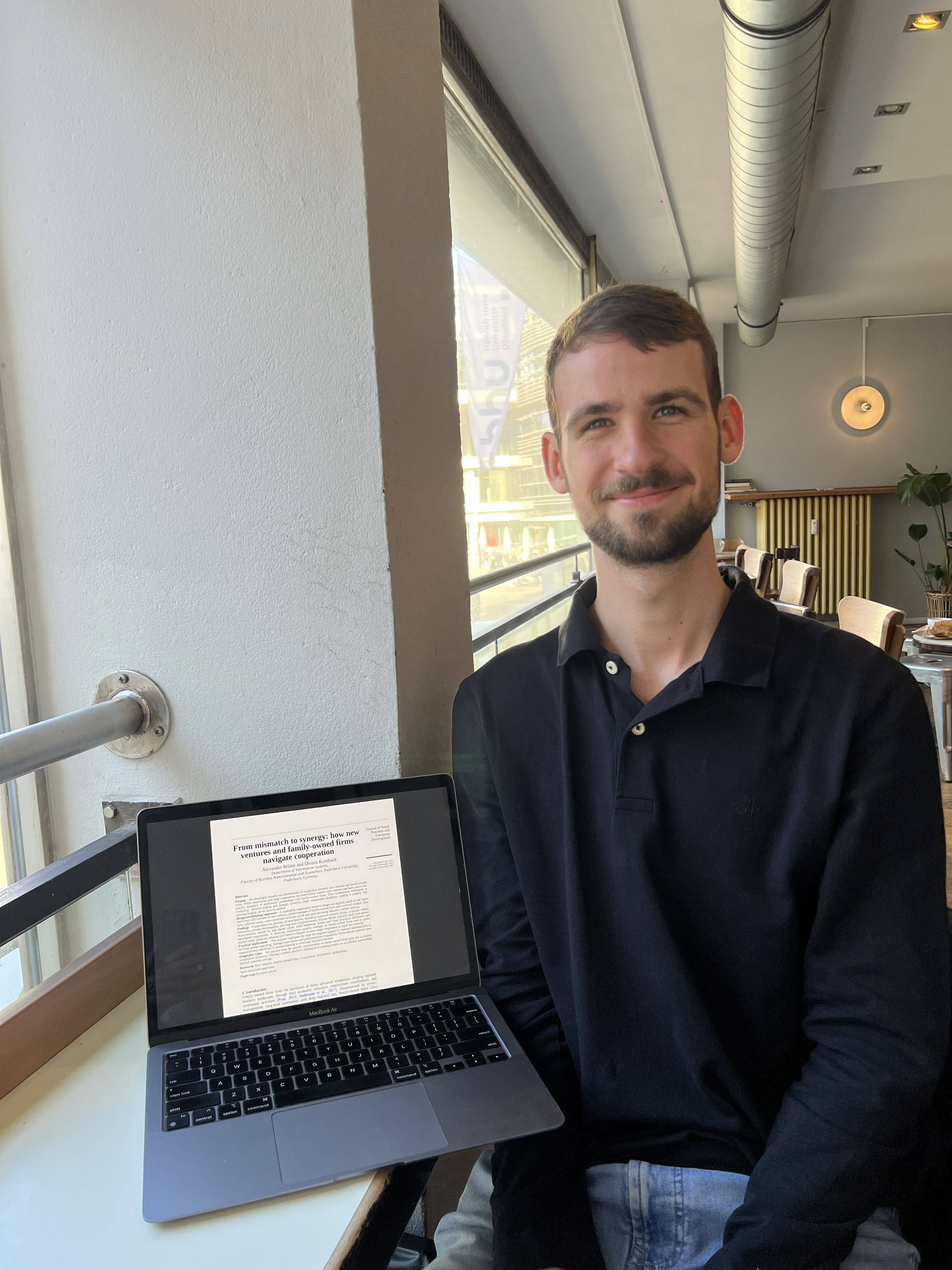
How Alexander published his first paper during his studies
At the age of 23, Alexander has achieved what many students dream of: a publication in a journal. The starting point was his bachelor's thesis in business informatics. In the Master's programme Management Information Systems programme at Paderborn University, he developed this into a publishable scientific paper in the #myfirstresearchpaper module.
Cooperations between start-ups and family-run companies
What added value do collaborations between start-ups and traditional, family-run companies create? And what success and disruption factors characterise this collaboration? Alexander addressed these questions in his bachelor's thesis. "Start-ups are often fast, experimental and strongly technology-driven. Family-run companies are usually long-term orientated, strongly value-based and focused on stability. These differences can create tensions - but also complementary effects," says Alexander, explaining his research project.
In his study, the Paderborn student shows that such collaborations can improve access to resources, promote innovation processes, positively influence corporate culture and strengthen competitiveness in the long term. This is particularly relevant for regions such as East Westphalia-Lippe, which are strongly characterised by family-run companies and face considerable innovation and transformation challenges. "Collaboration with start-ups can boost innovative strength here and secure jobs in the long term," explains Alexander.
From the Bachelor's thesis to the scientific paper
During his Master's degree, he came across the Department of Information Systems' #myfirstresearchpaper module, which specifically supports students in developing a scientific publication from a final thesis or seminar paper.
"It was nice to have the opportunity to do even more with my Bachelor's thesis. Final theses and term papers often disappear into a drawer after submission. My work now makes a real scientific contribution and can continue to create added value."
The biggest challenge: turning an original thesis into an independent research contribution. "It's not enough to present empirical results. It is crucial to show the extent to which they actually expand existing research."
Peer reviews as a reality check
The path to publication was challenging. Together with his supervisor, Prof Dr Dennis Kundisch, Alexander worked intensively on the structure, argumentation and theoretical classification. The simulated peer review made it clear how precisely scientific work is scrutinised: The feedback was detailed, critical and demanding - but it was precisely this that moved the work forward decisively.
After the final submission, the review phase began. Over the course of several months, revisions, clarifications and new votes followed. "Every piece of feedback forced me to scrutinise assumptions and sharpen arguments," reports Alexander. With success: the paper was accepted. "This was an additional achievement as part of my degree programme, which also represents a strong professional appreciation of my own work."
Research as a gain in competence
Looking back, #myfirstresearchpaper is one of the most formative modules of Alexander's degree programme. It gave him a realistic picture of academic work - from developing a clear research question and theoretical categorisation to dealing with critical feedback in a professional manner.
"I learnt how much care, structure and perseverance research requires," he says. "And that this effort is worth it."
Alexander has not only reached a personal milestone with his publication. He also shows how research-based teaching enables students to actively contribute to scientific discourse at an early stage.
You want that too?
Discover the diversity of economics in our Bachelor's degree programmes. Each degree programme usually lasts six semesters and prepares you for a career start or a postgraduate Master's degree. Master's programmes usually last four semesters and prepare you for a career start or a postgraduate doctorate.
More information about
- to the Bachelor's degree programme in Business Information Systems
- about the Master's degree programme in Management Information Systems