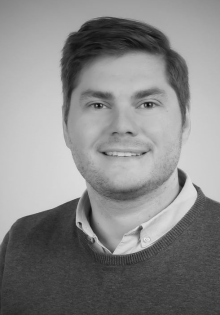
Professor Dr Tobias Bornemann taught and researched in Vienna for almost 15 years. In his work, he investigated how tax rules change the behaviour of global companies. Now he is returning to the place where his own academic career began: since the summer semester, the newly appointed Professor of International Corporate Taxation is at Paderborn University.
"It feels a bit like coming home - but with a different perspective," says Bornemann. His Bachelor's and Master's degrees and his first professional experience are linked to Paderborn University. Today, he returns as an academic; with international experience, new perspectives and a sharpened view of global economic issues.
Most recently, Bornemann worked for many years at the Vienna University of Economics and Business. Nevertheless, the decision in favour of Paderborn was made quickly. The Faculty of Business Administration and Economics has developed impressively in recent years: with internationally compatible research, strong profiles in sustainability and digitalisation as well as the DFG Collaborative Research Centre TRR 266 "Accounting for Transparency".
When taxes change behaviour
Bornemann's field of research sounds technical at first, but it touches on key social issues. How do tax rules influence business decisions? What happens when companies have to disclose in which countries they make profits and how much tax they pay there? And who ultimately bears the costs of new rules?
"I'm interested in how taxes change behaviour - and what happens when these decisions become visible to the public," he explains.
His research focuses on two areas: firstly, strategies used by multinational companies to reduce their tax burden and the effectiveness of political countermeasures such as the global minimum tax. On the other hand, he investigates whether transparency requirements actually lead to changes in behaviour or primarily generate additional reporting obligations.
His work repeatedly reveals a recurring pattern: regulatory interventions often have the effect that was politically intended, but can also fail to achieve their stated objective and at the same time have an unexpected effect. "The average effect rarely tells the whole story," says Bornemann. "The exciting findings are usually to be found in the side effects - and in the question of who ultimately bears the costs."
He considers the goals of tax and transparency-related regulation - climate neutrality, sustainable tax revenues, more transparency - to be correct and necessary. At the same time, the cost side has often been analysed too little to date. This is precisely where he sees a natural point of contact with Paderborn University: the Tax Complexity Index developed here has been documenting growing tax complexity for companies for years - what this complexity actually costs, on the other hand, has hardly been researched. "My point is not that we should regulate less," emphasises Bornemann. "We need to better understand what regulation costs. Only then can we distinguish between sensible regulation and poorly calibrated regulation."
Research with public responsibility
A defining moment in his career to date was when his team's research findings on the effect of taxes on management salaries found their way from specialist journals into the daily press. Suddenly, his academic findings became part of the public debate.
"That made me realise that research should not be pursued as an end in itself. Especially in times of misinformation and disinformation, science has a responsibility to be accessible and understandable," emphasises the newly appointed professor.
He also pursues this claim methodically. Bornemann works predominantly empirically and quantitatively with large international data sets. He uses econometric methods to analyse the real consequences of tax reforms, transparency obligations and regulatory interventions. These analyses are supplemented by qualitative insights, such as interviews with decision-makers at listed companies.
Teaching as a bridge between theory and practice
In the lecture theatre, Bornemann sees himself as a bridge builder: between students and current research, between departments and between university and practice. International taxation is an ideal field for this because economic, legal and social issues converge directly here.
Instead of memorised standard solutions, he relies on judgement under uncertainty. In case studies, students take on the role of real decision-makers, weigh up interests, work with incomplete information and defend their recommendations with arguments.
He expects his students to be curious, independent and willing to analyse complex problems in an argumentative manner. In return, they can expect a learning environment in which mistakes are part of the learning process and in which not only specialist knowledge but also judgement and communication skills can grow.
With his chair, he adds an international and strategic focus to the faculty's existing offerings. In the English-language Taxes and Business Strategy module, for example, students discuss how international companies react to sugar taxes, public criticism of tax strategies or new global rules.
In the future, he would also like to anchor topics such as transfer pricing, empirical tax research, tax tech and artificial intelligence more firmly.
Return with vision
After years in Vienna, Bornemann is not only looking forward to new research projects and classes, but also to familiar things, such as more regular visits to SC Paderborn 07.
In Professor Dr Tobias Bornemann, a scientist is returning to Paderborn who combines international perspectives with regional ties - and who wants to show how research on global issues can have a local impact.