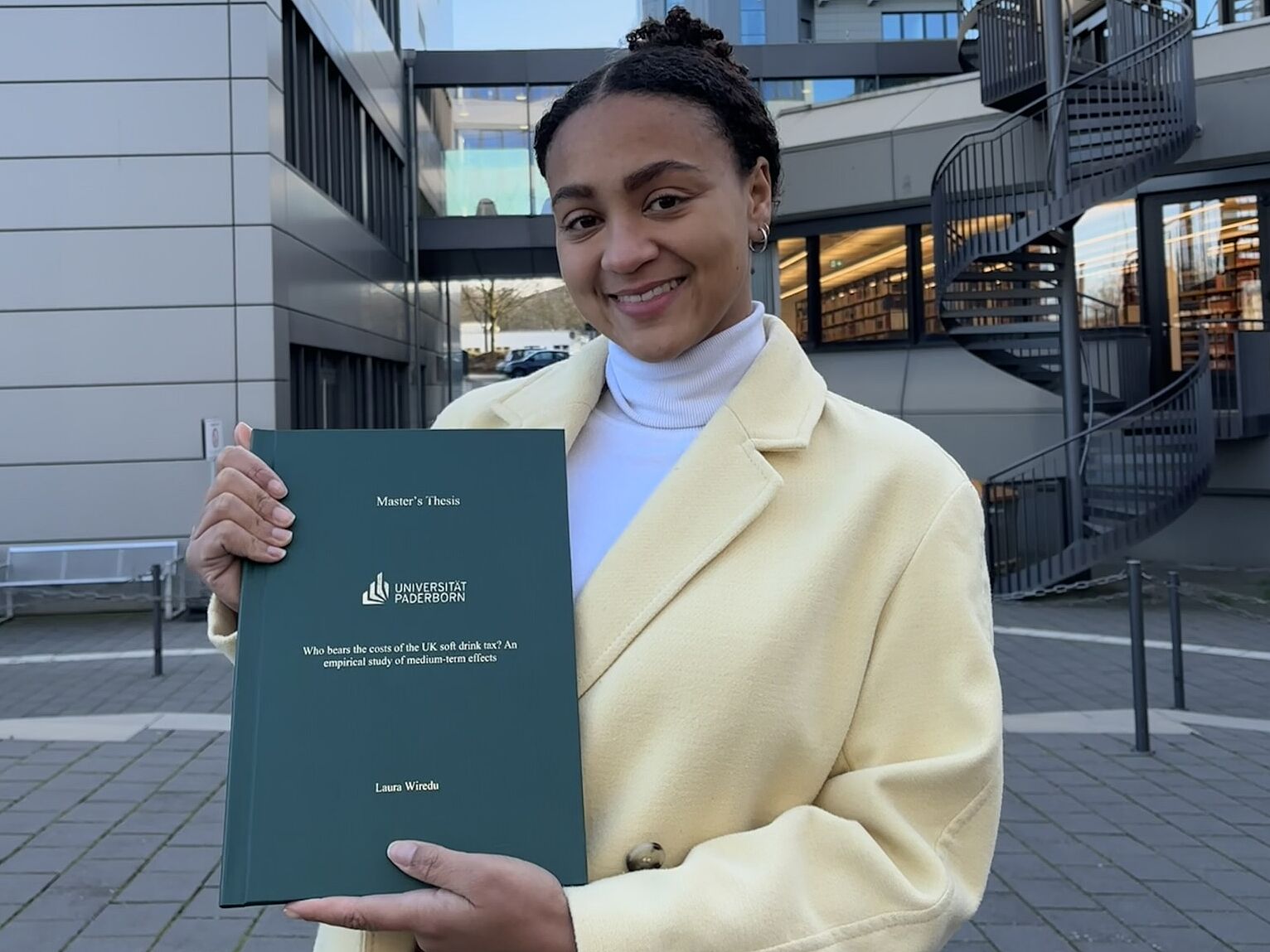
Laura's master's thesis on the current debate about a soft drinks tax
Laura Wiredu is 27 years old and studied at Paderborn University International Business Studies in the Bachelor and Business Administration in the Master's programme. She is now working as a research assistant at the Chair of Business Administration, in particular Business Taxation, and is working towards a doctorate. In particular, her master's thesis, in which she analysed the effects of the British soft drinks tax, has prepared her for her academic career.
Between health and the economy: the soft drinks tax
Heart attacks, diabetes and the like: excessive consumption of sugar can have serious health consequences. Nevertheless, various studies show that we consume too much of it. In Germany, there are therefore repeated discussions about a general sugar tax that would tax sugary products more heavily.
But what impact would such a tax have on consumers and employees? Laura addressed this question in her master's thesis. She analysed the medium-term effects of the British soft drinks tax introduced in 2018 and evaluated both price data and employment figures for the period from 2013 to 2023.
Making taxes tangible
Laura was fascinated by the topic right from the start: "At first glance, taxes often seem abstract, but there are also tangible examples such as the soft drinks tax. And as such taxes have been discussed in Germany for some time, I found it exciting to learn more about the effects," she explains.
The start of her master's thesis was structured: Coordinating the topic and research question, creating a timetable, finding data and researching literature. However, it soon became clear that the path would be more challenging than expected: "It wasn't easy to find literature that also related to employment figures in the soft drinks industry. Most of the studies only analyse price changes and don't look at the effects on employees."
Progress and challenges
The large number of different tax systems in different countries also made the research complex. New aspects, new studies and new methodological details kept cropping up. Step by step, she delved deeper into the topic, carried out her own analyses and presented her initial findings at the Master's colloquium. The feedback there helped her to further refine her work and adopt new perspectives.
Nevertheless, the process remained up and down: "There were days when everything fell into place and others when I felt like I wasn't making any progress," recalls the alumna. Laura's biggest challenge at the time: staying on the ball! This was particularly challenging whenever her results didn't seem plausible at first.
Who bears the costs of a soft drinks tax?
But what impact would a soft drinks tax have on employees and consumers? And who bears the costs? Laura's thesis shows that many of the frequently voiced fears cannot be confirmed for the UK in the medium term. There has been no visible decline in jobs in the soft drinks industry, nor has there been a significant burden on consumers.
A look at prices also puts the criticism into perspective: drinks prices fell overall during the period analysed. Prices for sugary soft drinks only fell by around 6% less than those for non-taxed drinks. This indicates that producers only passed on a small part of the tax to consumers. Overall, a differentiated picture emerges: Neither consumers nor employees had to bear the costs of the UK soft drinks tax to any significant extent in the medium term.
The feeling after the submission
When Laura handed in her master's thesis, a great burden fell away from her: "During the writing process, I was often afraid of not achieving my own performance goals. But after handing it in, I was relieved and happy".
Looking back, her master's thesis taught her to work intensively on a topic over a longer period of time, to endure setbacks and to constantly restructure herself. This experience has not only shaped Laura professionally, but also personally and is an important foundation for her with regard to her planned doctorate.
You want that too?
Discover the diversity of Business Administration and Economics in our Bachelor's degree programmes. Each study programme usually lasts six semesters and prepares you for a career start or an advanced Master's degree. Master's degree programmes usually last four semesters and prepare you for a career start or a postgraduate doctorate.
More information about
- to the Bachelor's degree programme in International Business Studies
- to the Master's degree programme in Business Administration