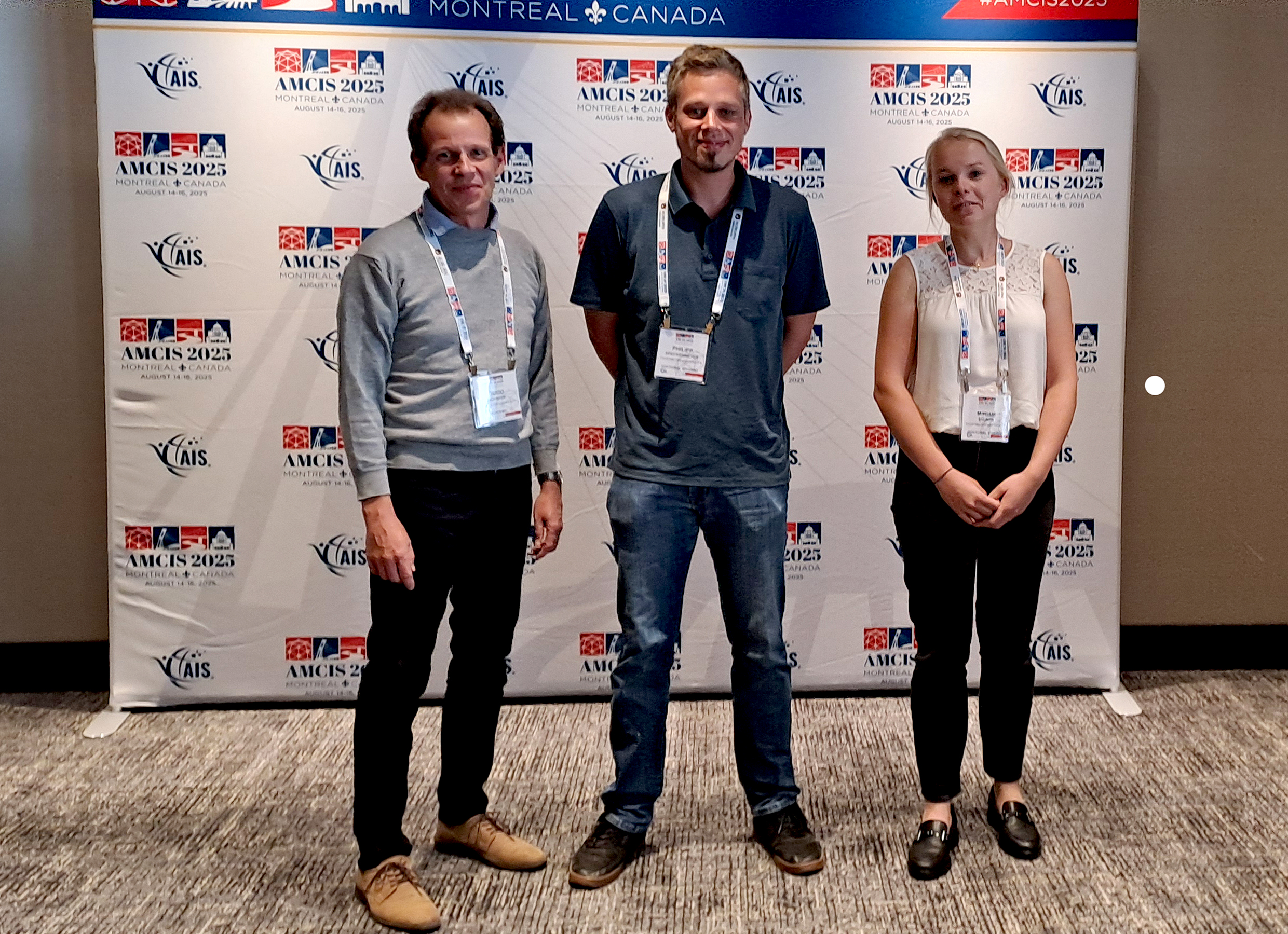
Anlässlich der „AMCIS (America's Conference on Information Systems) 2025“ in Montreal in Kanada wurden 2 aktuelle Forschungspapiere des Lehrstuhls (Frau Dr. Miriam Stumpe, Herr Philipp Speckenmeyer und Herrn Prof. Dr. Guido Schryen) zur Präsentation und nachfolgenden Publikation in den Proceedings der Konferenz angenommen. Frau Stumpe, Herr Schryen und Herr Speckenmeyer hatten die Gelegenheit, ihre Beiträge einem internationalen Fachpublikum vorzustellen und erhielten wertvolle Anregungen für ihre weitere Forschung.
Wir gratulieren Frau Dr. Stumpe, Herrn Prof. Schryen und Herrn Speckenmeyer herzlich zu diesem Erfolg!
M. Stumpe, P. Speckenmeyer, G. Schryen, L. Kleinjohann, C. Weskamp, in: Proceedings of the Thirty-First Americas Conference on Information Systems (AMCIS 2025), Montréal, Canada, 2025:
Planning a Swarm-Based Mobility System with Autonomous Vehicles for Sustainable and Flexible Transportation in Rural Areas
Rural areas face significant mobility challenges due to low population density, limited public transportation, and a high dependence on private vehicles, leading to restricted access for non-vehicle owners and environmental issues. This paper presents a decision support system (DSS) currently developed within the NeMo.bil project, which explores a swarm-based, on-demand mobility system using autonomous vehicles to address these challenges. The DSS integrates strategic fleet planning with real-time operational planning to optimize resource allocation and demand response. A sample use case illustrates how the tool is intended to support decision-making for fleet sizing and configuration in rural regions. As this research is ongoing, we present a preliminary concept of the DSS and outline future research directions.
https://ris.uni-paderborn.de/record/61368
J. Göbel, H. Betke, J. Boldt, M.L. Tran, G. Schryen, in: Proceedings of the Thirty-First Americas Conference on Information Systems (AMCIS 2025), Montréal, Canada, 2025:
The Impact of Chatbot Familiarity and Frequency of Use on Human-Likeness
This study investigates the relationship between user familiarity, frequency of use, and perceptions of human-like qualities in chatbots. Using survey data from 357 participants interacting with three simple chatbots, we examined how familiarity and frequency of use correlate with perceptions of human-likeness. Results revealed modest but statistically significant positive correlations, supporting our hypothesis that increased familiarity and usage frequency lead to stronger anthropomorphic perceptions. Regression analyses showed that familiarity and usage frequency accounted for 6.2% and 5.4% of the variance in perceived human-likeness, respectively. These findings align with Epley's Three-Factor Theory of Anthropomorphism, particularly the roles of elicited agent knowledge and effectance motivation. The study highlights the importance of users’ past experience in shaping anthropomorphic perceptions. Future research should explore additional factors influencing perceived human-likeness in chatbot interactions.