Welcome to the website of the Chair of Information Systems and Data Analytics! Our research and teaching focus on the question of how humans interact with artificial intelligence to make better decisions.

FLEM­ING-Pro­jekt of­f­iz­i­ell ge­star­tet

Kick-Off des Projekts FLEMING
Mit einer Kick-Off Veranstaltung am ABB Forschungszentrum Deutschland in Ladenburg ist das Forschungsprojekt „FLEMING – Flexible Monitoring- und Regelsysteme für die Energie- und Mobilitätswende im Verteilnetz durch Einsatz von Künstlicher Intelligenz“ gestartet. In einem ersten Schritt verschafften sich die Forschungs- und Wirtschaftspartner unter der Projektleitung von ABB einen umfassenden Überblick über die anstehenden Arbeiten und Ziele des Projekts. Neben dem ABB Forschungszentrum Deutschland beteiligen sich das Forschungsinstitut für Rationalisierung e.V. (FIR), die Heimann Sensor GmbH, das Karlsruher Institut für Technologie (KIT), der SICP – Software Innovation Campus Paderborn an der Universität Paderborn sowie die SÜC Energie und H2O GmbH aus Coburg am Projekt. Für FLEMING ist eine Laufzeit von drei Jahren vorgesehen. Die Gesamtkosten belaufen sich auf 5,1 Millionen Euro, das Fördervolumen liegt bei ca. 3,3 Millionen Euro.

Gleichbleibende Versorgungsqualität
„Das deutsche Verteilnetz ist derzeit mit verschiedenen Herausforderungen konfrontiert. Auf der Erzeugungsseite steigt der Anteil von dezentral in das Verteilnetz eingespeister Energie aus erneuerbaren Quellen mit volatiler Erzeugungscharakteristik, z.B. Solaranlagen und Windkraftanlagen. Auf der Verbrauchsseite führt die zunehmende Integration von Ladesäulen für die
Elektromobilität zu einer zeitlich und räumlich konzentrierten Energienachfrage.
Die daraus resultierenden möglichen Lastschwankungen führen zu einer stärkeren Belastung der elektrischen Betriebsmittel und Komponenten,“ erläutert Projektleiter Dr. Oliver Becker, Senior R&D Project Manager am ABB Forschungszentrum Deutschland. Um die Ziele der Energie- und Mobilitätswende bei gleichbleibender
Versorgungsqualität zu erreichen, benötigen die Netzbetreiber ein verbessertes Verständnis des aktuellen Netzzustandes und seiner Komponenten. Genau hier setzt das Forschungsprojekt an. Anlagenausfälle oder potentielle Schäden können somit frühzeitig erkannt bzw. vorhergesagt oder durch verbesserte Regelung vermieden werden. Dazu werden im Rahmen eines intelligenten
Lastmanagements zuverlässige und leicht nachrüstbare Sensoren zur Regelung benötigt, wodurch eine flexiblere Netznutzung ermöglicht werden soll.

Bei erneuerbaren Energien auf Künstliche Intelligenz setzen
Das beschriebene Szenario verlangt nach einem durchgängigen Einsatz von Sensorik, Informations- und Kommunikationssystemen zur Erfassung der nötigen Daten der einzelnen Netzbetriebsmittel und -komponenten. Daher untersuchen die Projektpartner im Projekt FLEMING, wie der heutige Sensoreinsatz in Verteilnetzen durch Verwendung von Methoden der
Künstlichen Intelligenz zusammen mit einer Erweiterung der Sensortechnik grundlegend verbessert werden kann. Ziel ist es, so wesentlich zum Erfolg der Energie- und Mobilitätswende in Deutschland beizutragen.

Re­search

Our research aims to improve human decision-making through the responsible use of data and algorithms. We follow a socio-technical approach that integrates cutting-edge technologies—especially machine learning and artificial intelligence—with social and societal considerations.

Human-AI Interaction
We investigate how people interact with AI systems in economic decision-making processes. Our work identifies individual and contextual factors that drive acceptance or rejection, and we quantify how AI support affects outcomes such as productivity and decision quality in business environments.

AI for Sustainable Energy
We develop and evaluate intelligent systems that support the generation, distribution, and use of clean and affordable energy. We do this in both industrial processes and residential settings.

Sports Analytics
We use fine-grained event and tracking data to support data-driven decision-making in professional sports. Our work spans applications such as scouting, performance analysis, and tactical evaluation—primarily in football and handball.
 

soda.lab - So­cial & Data-In­tens­ive Com­put­ing Lab

The soda.lab is available to our students for final theses and modules in the Department of Information Systems. It includes powerful servers and workstations with GPUs that enable deep learning, complex simulations and realistic visualizations in real time.

Mitarbeitende tauschen sich auf Sofa aus.

Pub­lic­a­tions

We publish our research results in the leading scientific journals and at international conferences.

Mitarbeiter schreibt etwas an eine Tafel.

Pro­jects

Our application-orientated research often takes place in interdisciplinary projects with members from research and practice.

Teaching

We offer lectures and seminars at the Bachelor's, Master's, and Doctoral levels.

Bachelor

Module nameModule typeSemesterECTSLanguage
Fundamentals of management information systemsLecturesummer semester5DEU
Methods of Data Science (Film)Lecturewinter semester5DEU
Data VisualizationSeminarsummer semester5DEU
Predictive AnalyticsStudent research projectsummer /winter semester5DEU/ENG


Master

Module nameModule typeSemesterECTSLanguage
Data Science for BusinessLecturewinter semester5ENG/DEU
Applied Machine Learning for Text AnalysisSeminarwinter semester10ENG/DEU
Real-World Machine Learning ProjectsSeminarsummer semester10ENG/DEU


Doctorate

Module nameModule typeSemesterECTSLanguage
Machine Learning for ResearchSeminarsummer semester (irregular)6ENG


Application

The Department of Information Systems does not participate in the centralized allocation procedure of the Faculty of Business Administration and Economics. Consequently, the application process varies for each chair.

Our application deadlines are as follows:

  • Winter semester: January 1 - February 28 (29)
  • Summer semester: July 1 - August 31

To apply, please submit the following:

  • Curriculum vitae
  • Current transcript of records
  • Letter of application

Your letter should express your interest in "Data Analytics" topics and include suggested themes for your thesis. Please email your complete application to the chair.

We emphasize the importance of a strong interest in a topic as a key to success. Rather than publishing pre-defined topics, we encourage students to bring their own interests and define their thesis topics in consultation with a chair member.

Occasionally, we offer theses with practice partners, where topics are usually predefined. If applicable, you will find these under the relevant heading.

Preparation (template)

Please use this LaTeX template as a guide when designing your thesis !

Mas­ter's thes­is with op­tion­al in­tern­ship in the field of "Pat­ent Ana­lyt­ics" (Wil­helm Böll­hoff GmbH & Co. KG, Biele­feld)


Patents offer two essential functions, namely protection against imitation and the provision of information.

The information function of patents is currently little utilised by companies. However, the potential for utilising information is very high, as it is estimated that 90% of the technical knowledge published worldwide can be found in the patent literature. The currently emerging field of "patent analytics", which is also referred to in the literature as "IP intelligence", for example, is concerned with the procurement, analysis and processing of information from published patents and patent register data.

IP intelligence utilises the fact that patents contain structured bibliographic information such as applicant data, inventor data, time data and technical classifications. The published information on forward and backward citations also offers opportunities for gaining knowledge.

On the other hand, the contents of patent specifications, such as the technically detailed descriptions of the inventive embodiments and the problems to be solved as well as the technical illustrations contained therein, also offer great informative potential. This can be utilised, for example, through semantic, AI-based analyses to identify current technical problems and solutions.

Other information published in the context of patent applications also offers a currently underutilised potential (data on disputes, examination procedures, etc.).

Companies can utilise this information function for better strategic decision-making. For example, idea generation processes for product innovations can be supported. This information is also helpful for identifying new markets or collaborations or M&A, evaluating applicants and analysing patent dependencies.

The aim of the work is to develop and evaluate methods for analysing patent data. These methods will then be used to demonstrate the entrepreneurial benefits of specific case studies.

All details can be found here

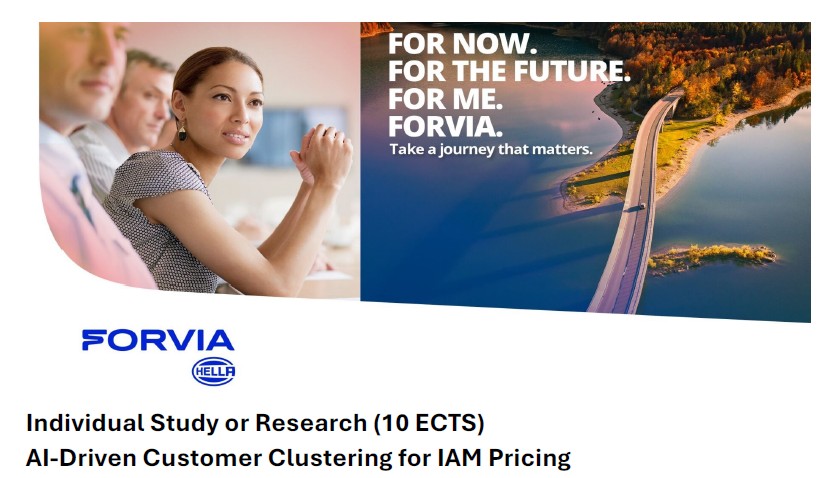
AI-Driv­en Cus­tom­er Clus­ter­ing for IAM Pri­cing (FOR­VIA HELLA)

Die Abteilung Global Pricing IAM bietet dir ein spannendes und aktuelles Forschungsumfeld: die Analyse und Optimierung von Customer Clustering mit künstlicher Intelligenz. Im komplexen und wettbewerbsintensiven Independent Aftermarket (IAM) ist intelligentes Kundengruppen-Management ein zentraler Erfolgsfaktor für effektive Preisgestaltung. Mit deiner Seminararbeit zu Customer Clustering mit KI / ML kannst du direkt an einem zukunftsrelevanten Pricing-Thema arbeiten. Diese Arbeit bietet dir die Möglichkeit:

- bestehende Cluster-Modelle kritisch zu analysieren
- AI-basierte Methoden zu bewerten,
- Stärken und Schwächen aktueller Ansätze im HELLA-IAMKontext herauszuarbeiten,
- konkrete Verbesserungsansätze zu entwickeln, die zu präziseren und wertorientierteren Kundensegmenten führen.

Alle Details zur Bewerbung finden sich im PDF hier.

Team

Meet the brilliant minds driving research and teaching at the Data Analytics Group. Our team is an interdisciplinary blend of experts, each passionate about data-driven decision making in domains ranging from energy over finance to sports.

Find out more about our team here!

Join our team!

Become part of our team, either as a student assistant or research assistant with a Bachelor's degree or as a research assistant after completing your Master's degree.

Con­tact

Wirtschaftsinformatik, insb. Data Analytics

Paderborn University
Warburger Str. 100
33098 Paderborn
Send E-Mail Directions