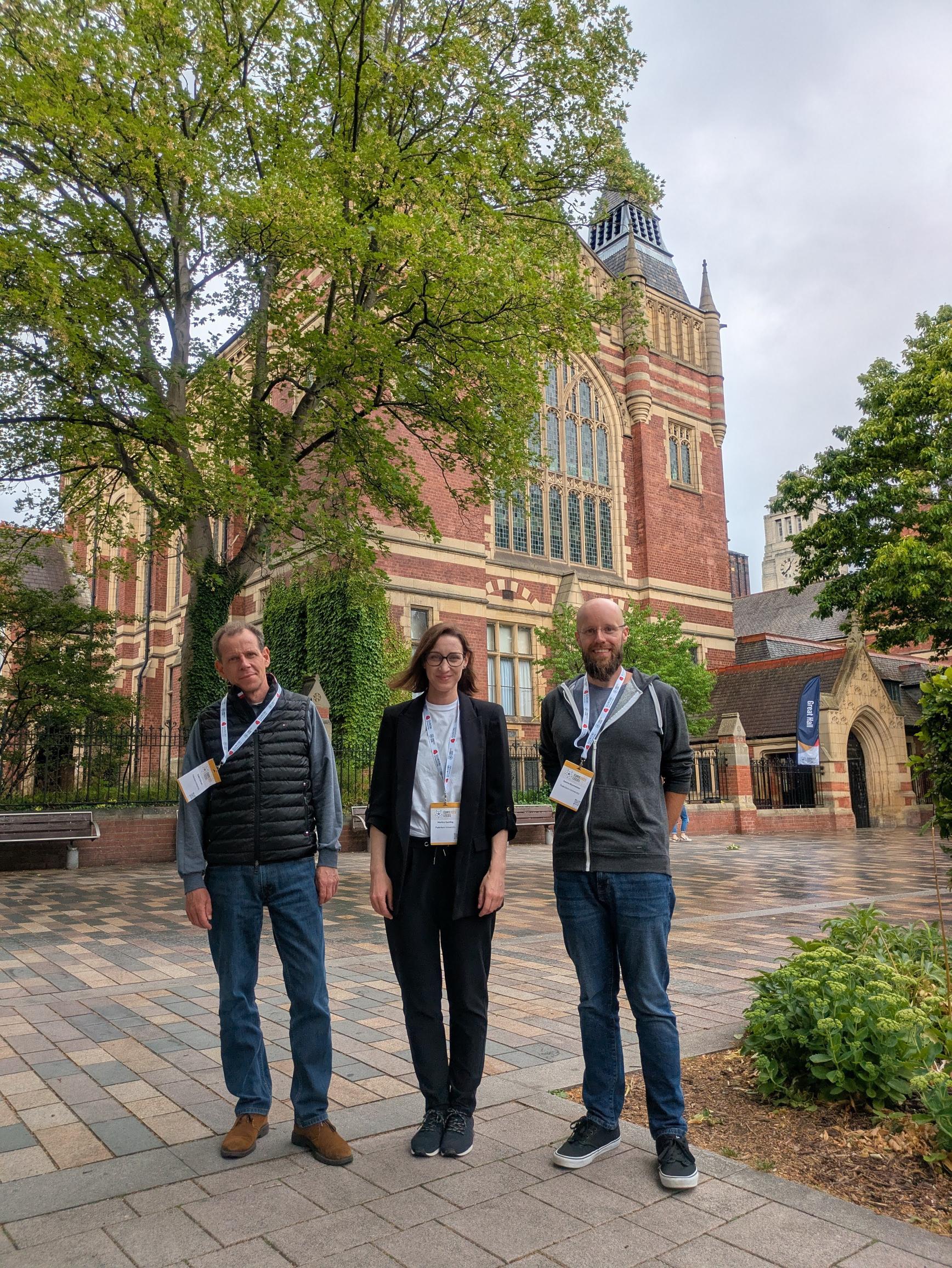
Anlässlich der „34th European Conference on Operational Research (EURO 2025)“ in Leeds wurden die aktuellen Forschungspapiere unserer beiden Promovierenden, Martina Sperling und Sascha Burmeister, zur Präsentation angenommen. Beide hatten die Gelegenheit, ihre Beiträge einem internationalen Fachpublikum vorzustellen und erhielten wertvolle Anregungen für ihre weitere Forschung.
Wir gratulieren Martina und Sascha herzlich zu diesem Erfolg!
Martina Sperling:
A heuristic approach for disaster response - matching and scheduling unaffiliated spontaneous volunteers
In large-scale disasters, such as natural or man-made catastrophes and pandemics, the shortage of resources and personnel can limit the effectiveness of rescue efforts. At the same time, many civilians are eager to help their communities. Unaffiliated spontaneous volunteers play an important role in improving disaster response, but coordinating them is a major challenge for relief organizations (e.g., Red Cross, fire departments). Effectively managing these volunteers requires careful planning, clear communication, and a good understanding of available resources, all of which can significantly influence the outcome for those affected. Coordinating spontaneous volunteers using exact methods can be computationally challenging due to the NP-hard complexity of our problem. While exact methods provide high-quality solutions, they often lack the runtime efficiency needed in urgent scenarios. We propose a greedy heuristic, which balances runtime efficiency with solution quality. Using data from a real-world flood scenario, the approach is compared to an exact method using the Gurobi solver. The results show that the heuristic is a viable alternative for relief organizations, offering a good balance between speed and solution quality.
Sascha Burmeister:
Comparative Analysis of Evolutionary Algorithms for Energy-Aware Production Scheduling
The energy transition is driving rapid growth in renewables, requiring manufacturers to balance energy demand with price awareness. Energy-aware production planning aligns demand with dynamic grid conditions, supporting renewables while reducing costs and emissions. This can be modeled as a multi-criteria scheduling problem, where the objectives extend beyond traditional metrics like makespan or required workers to also include minimizing energy costs and emissions. Due to frequent recalculations and the NP-hard multi-objective nature of the problem, evolutionary algorithms are widely used. However, research often focuses on single algorithms with limited comparative studies. This study adapts NSGA-III, HypE, and theta-DEA as memetic metaheuristics for energy-aware production scheduling, minimizing makespan, energy costs, emissions, and workforce in a real-time energy market. These adapted metaheuristics present different approaches for environmental selection. In a comparative analysis, we explore differences in solution efficiency and quality across various scenarios which are based on benchmark instances from the literature and real-world energy market data. Additionally, we estimate upper bounds on the distance between objective values obtained with our memetic metaheuristics and reference sets obtained via an exact solver.